
Liquid Fertilizers Market to Reach USD 20 Billion by 2034, Growing at 2.60% CAGR | IMARC Group
Liquid Fertilizers Market Graph 2026
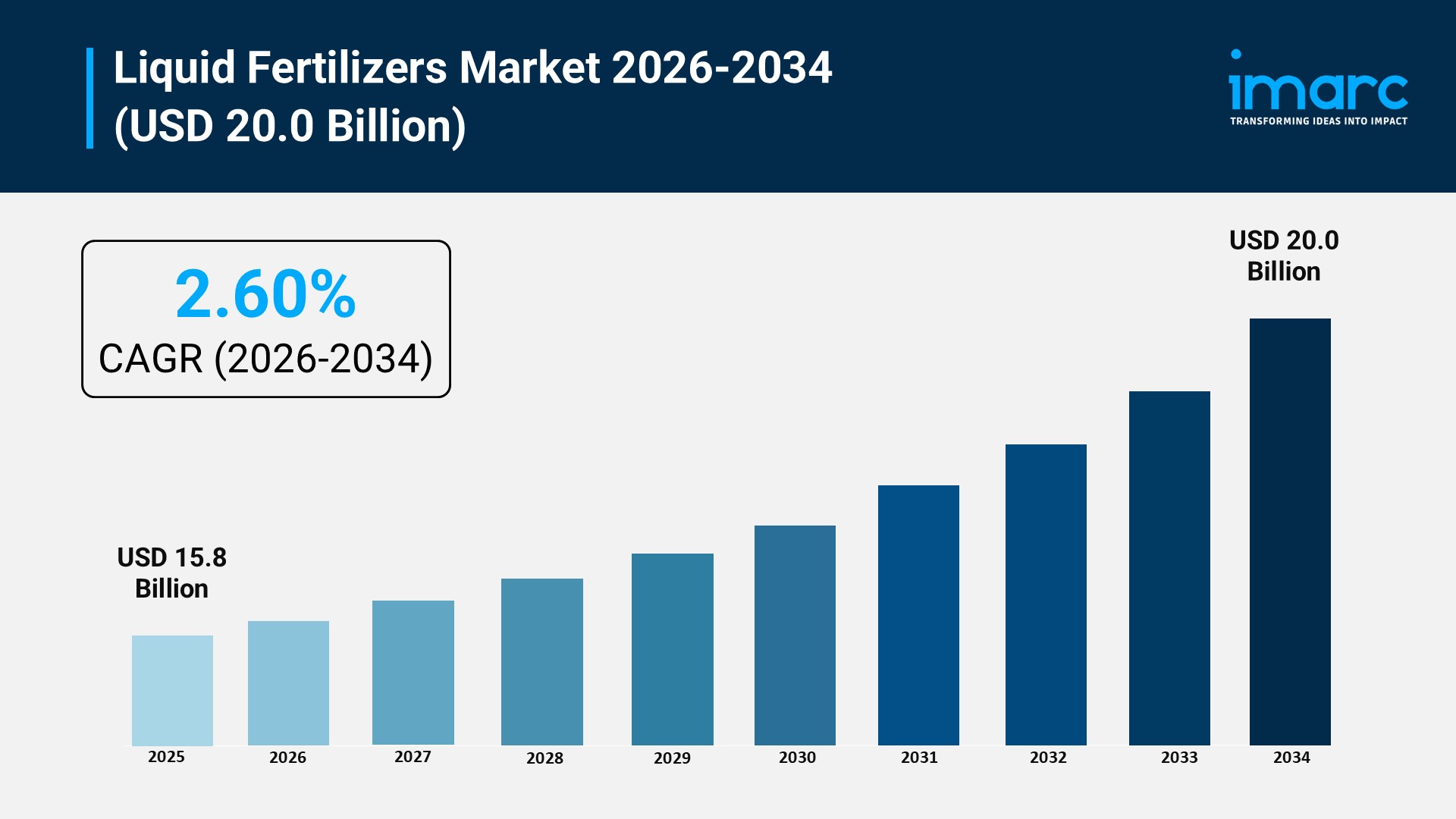
The global liquid fertilizers market size reached USD 15.8 billion in 2025.
SHERIDAN, WY, UNITED STATES, May 14, 2026 /EINPresswire.com/ -- The next decade of agriculture will not be won on acreage alone. It will be won on how efficiently every drop of nutrient reaches the root zone, and that is exactly why the liquid fertilizers market has moved from a niche category into one of the most strategically interesting plays in modern agri-input portfolios. For nutrient suppliers, distributors, equipment manufacturers, agri-tech vendors, and private equity investors hunting durable demand, the forecast window from 2026 to 2034 is a clear runway.The global liquid fertilizers market size reached USD 15.8 Billion in 2025 and is projected to climb to USD 20.0 Billion by 2034, expanding at a CAGR of 2.60% during 2026 to 2034. The growth is being engineered by efficient nutrient delivery, ease of application, rising global demand for high-quality crops, environmental concerns, and the accelerating adoption of precision agriculture across cereals, oilseeds, fruits, and vegetables.
Download a sample copy of the report: https://www.imarcgroup.com/liquid-fertilizers-market/requestsample
Liquid Fertilizers Market Forecast: Size, Share, and the Growth Math
The headline numbers anchor the commercial opportunity. Over the forecast window, the category will add roughly USD 4.2 Billion in incremental revenue, with growth concentrated in regions and crop segments that combine large cultivated areas with rapid mechanization. The liquid fertilizer market share breakdown shows clear leaders that decision makers cannot ignore:
Nitrogen represents the largest type segment, powered by its central role in vegetative growth, protein formation, and chlorophyll production.
Organic production processes hold the largest share, reflecting the global pivot to sustainable agriculture and soil-health-driven farming.
Grains and cereals account for the largest crop segment, driven by their status as global food staples.
Fertigation leads the mode-of-application split, supported by its compatibility with precision farming and drip irrigation systems.
Asia Pacific dominates the regional market, but North America and Europe are emerging as the highest-margin, technology-led battlegrounds.
For revenue strategists, the message is straightforward. Volume growth lives in cereals and Asia. Margin growth lives in fruits, vegetables, and Western markets that pay a premium for precision and sustainability.
Where Is the Real Revenue Hiding? A Crop-by-Crop Opportunity Map
The crop segmentation is where the liquid fertilizers market opens distinct commercial lanes for manufacturers and distributors.
Cereals and Grains: The Volume Engine
Grains and cereals form the foundation of global food supply, consumed by billions across every continent. As populations grow, demand for wheat, rice, corn, and barley stays structurally elevated, driving the need for efficient nutrient management to deliver consistent yields. These crops are cultivated across diverse agro-climatic regions, translating into massive, recurring liquid fertilizer demand. Their compatibility with both traditional methods and precision agriculture techniques makes them the volume backbone of the category.
Oilseeds and Pulses: The Strategic Margin Play
Soybean, sunflower, canola, and pulses are gaining commercial weight as protein demand rises and biofuel supply chains expand. Liquid fertilizer formulations targeting nitrogen fixation, micronutrient correction, and foliar feeding are particularly relevant in this segment, offering input providers room to differentiate on product science rather than commodity pricing.
Fruits and Vegetables: The Premium Tier
This is where the premium liquid fertilizers market unlocks. Consumers across North America and Europe are paying more for fresher, more nutritious, residue-controlled produce. Growers in turn are investing in liquid nutrition that improves taste, color, shelf life, and nutritional content. Foliar sprays, drip-fed micronutrient solutions, and bio-stimulant-enhanced formulations are commanding higher price points and stronger margins compared to bulk granular inputs.
Others: Specialty, Turf, and Ornamentals
Ornamental horticulture, turfgrass, urban agriculture, and hydroponics are emerging adjacent markets where liquid fertilizers are the default rather than the alternative.
How Is North America Reshaping the Liquid Fertilizers Market Share?
North America, anchored by the United States and Canada, is positioning itself as the technology-led growth pole of the global liquid fertilizers market. The region's farms are heavily mechanized, irrigation infrastructure is mature, and adoption of precision agriculture continues at scale. American growers are increasingly integrating fertigation with sensor-based moisture monitoring, drone-led foliar applications, and data analytics platforms that optimize nutrient timing.
Three commercial dynamics make the US a particularly attractive market for liquid fertilizer suppliers:
High-value row crops such as corn and soybeans dominate cultivation, creating large, repeatable demand pockets.
Premium horticulture clusters in California, Florida, Washington, and Michigan support continuous demand for specialty liquid blends targeting fruits, vegetables, and nuts.
Sustainability-driven procurement by major food retailers is pushing growers toward organic and bio-based liquid fertilizers, opening a clear premium segment.
The result is a North American market where vendors who can pair liquid nutrition with digital agronomy services are positioned to capture disproportionate liquid fertilizer market share.
Request Customization: https://www.imarcgroup.com/request?type=report&id=5886&flag=E
What Makes Europe a High-Stakes Battleground for Liquid Fertilizer Vendors?
Europe is the regulatory and sustainability heartbeat of the global category. Markets including Germany, France, the United Kingdom, Italy, Spain, and Russia are reshaping product development priorities through tighter rules on nutrient runoff, nitrate pollution, and synthetic input usage. These pressures are accelerating the shift toward organic liquid fertilizers and slow-release formulations that align with EU Green Deal and Farm to Fork targets.
European growth lanes worth flagging:
Specialty crops in Spain, Italy, and France, including citrus, wine grapes, olives, and greenhouse vegetables, demand high-precision foliar and fertigation solutions.
Cereal belts across France, Germany, and Eastern Europe continue to anchor volume demand for nitrogen-based liquid inputs.
Sustainable farming mandates are creating a premium for bio-stimulant-enhanced and reduced-emission liquid fertilizers.
Distribution consolidation among agri-cooperatives is reshaping how vendors approach go-to-market strategy.
For vendors building European commercial plans, alignment with regulatory roadmaps, traceable sourcing, and quantified yield-and-emission data will increasingly matter more than headline product specs.
Why Are Farmers Switching to Liquid Fertilizers Faster Than Expected?
Several structural forces are accelerating adoption across both developed and developing markets:
Efficient nutrient delivery minimizes leaching and nutrient loss, ensuring crops receive nutrients when they need them most.
Ease of application through foliar spraying, drip irrigation, and fertigation reduces labor costs and saves time.
Compatibility with agrochemicals allows combined application, streamlining operations.
Rising demand for high-quality crops ties directly to consumer preferences for nutritionally dense, residue-controlled produce.
Environmentally friendly formulations reduce nutrient runoff and groundwater contamination, aligning with sustainable agriculture policies.
Precision agriculture compatibility supports data-driven nutrient application that maximizes ROI per hectare.
Urban agriculture and hydroponics are creating fresh demand pockets where precise nutrient solutions are non-negotiable.
Bio-stimulant and slow-release innovations are unlocking higher-margin product tiers.
Liquid Fertilizers Market Segmentation: A Strategic Snapshot
By Type
Nitrogen (leading segment), Phosphorous, Potash, and Micronutrients.
By Production Process
Organic (leading segment) and Synthetic.
By Crop
Grains and Cereals (leading segment), Fruits and Vegetables, Oilseeds and Pulses, Others.
By Mode of Application
Soil, Fertigation (leading segment), Foliar, Others.
By Region
Asia Pacific (leading region), North America, Europe, Latin America, and Middle East and Africa.
Who Are the Major Players in the Global Liquid Fertilizers Market?
The competitive landscape is shaped by global agri-input majors and specialty liquid-fertilizer innovators. Companies covered in the report include:
AgroLiquid
COMPO Expert GmbH (Grupa Azoty S.A.)
Haifa Group
ICL Group Ltd.
K+S Aktiengesellschaft
Kugler Company
Nutrien Ltd.
Nutri-Tech Solutions Pty Ltd.
Plant Food Company Inc.
Tessenderlo Group
Yara International ASA
These players are investing heavily in R&D, customized formulations, bio-stimulant integration, and digital agronomy platforms that pair products with sensor and drone-based decision tools.
Recent Developments Shaping the Competitive Landscape
ICL Group Ltd. completed the acquisition of Compass Minerals America do Sul S.A., including its South American Plant Nutrition business, expanding its footprint in liquid fertilizer manufacturing and reinforcing its position across the Americas.
AgroLiquid launched springuP, an innovative liquid phosphorus solution designed to address evolving nutrient delivery challenges and support precision-based crop nutrition.
Yara International ASA completed the acquisition of Vale Cubatao Fertilizantes in Brazil, strengthening its Latin American manufacturing capacity and expanding its broader portfolio of crop nutrition offerings.
Each move points to the same strategic theme: consolidation around regions with high agricultural intensity and product portfolios that lean into precision, sustainability, and value-added formulations.
Speak to an analyst for customization: https://www.imarcgroup.com/request?type=report&id=5886&flag=C
Challenges in the Liquid Fertilizers Market
For manufacturers, distributors, and investors building a commercial strategy in the liquid fertilizers market, several friction points need attention:
Raw material price volatility for nitrogen, phosphate, and potash, which compresses gross margins.
Regulatory tightening across the EU, US, and parts of Asia on nitrate runoff and emissions.
Logistics complexity for liquid bulk transport, storage, and last-mile delivery to farms.
Farmer education gaps, particularly in emerging markets where granular fertilizers remain the default.
Counterfeit and low-quality formulations that erode trust and brand equity in price-sensitive geographies.
Companies that address these pain points through localized manufacturing, certified product traceability, agronomy-led sales models, and bundled digital tools will capture outsized liquid fertilizer market share through 2034.
About IMARC Group
IMARC Group is a leading global market research company providing data-driven insights and expert consulting services to businesses seeking to achieve their strategic objectives. With a multi-disciplinary team of industry experts, IMARC delivers thorough, reliable market intelligence across sectors including agriculture, chemicals and materials, food and beverages, healthcare, and energy.
Elena Anderson
IMARC Services Private Limited
+1 201-971-6302
email us here
Legal Disclaimer:
EIN Presswire provides this news content "as is" without warranty of any kind. We do not accept any responsibility or liability for the accuracy, content, images, videos, licenses, completeness, legality, or reliability of the information contained in this article. If you have any complaints or copyright issues related to this article, kindly contact the author above.
